

What Are the Top Rotomolding Chair Types in 2026?

Outdoor spaces are becoming extensions of everyday living, and furniture choices now balance comfort, durability, and visual appeal. Grand View Research estimated the global outdoor furniture market at USD 50.79 billion in 2023, with projected growth through 2030. That figure covers many product categories, not rotomolded chairs alone. Still, it signals a broader market where practical outdoor seating matters.

A Rotomolding Chair is made by heating resin inside a rotating mold, forming a hollow, often seamless shell. The process can support rounded shapes, sturdy construction, and designs suited to patios, cafés, poolsides, and public spaces. But “durable” does not mean indestructible. Resin choice, wall thickness, UV exposure, and everyday handling all affect long-term performance. A chair left in harsh sun may age differently from one kept beneath a covered terrace.

This guide compares the leading rotomolding chair types expected to attract attention in 2026, from compact dining designs to lounge and commercial seating. It considers comfort, stability, maintenance, and where each style works best. The evidence has limits: market reports rarely isolate rotomolded chairs as a separate segment. So the rankings should be read as a practical buying framework, not a definitive sales league table. A close inspection still matters. Check the base, seat depth, and surface finish before choosing.
What Are the Top Rotomolding Chair Types in 2026?

Rotomolding Chairs: Definition and Manufacturing Process

Rotomolding Chairs: Definition and Manufacturing Process

Rotomolding chairs are hollow plastic seats formed inside a heated, rotating mold. Unlike injection molding, the process uses relatively low pressure. A measured amount of polymer powder enters the mold, which rotates along two axes as it heats. The powder melts, coats the inner walls, and gradually forms a continuous shell. After cooling, workers remove the chair and trim openings or edges. The result can be lightweight, weather-resistant, and free of seams across many surfaces. That does not make every chair equally comfortable; shape, wall thickness, and support still matter.

The Association of Rotational Molders describes rotational molding as a process suited to hollow, seamless plastic products. For broader context, Plastics Europe reported global plastics production of 413.8 million tonnes in 2023; this figure covers all plastics, not rotomolded furniture. Tooling and cycle settings influence consistency, while cooling too quickly can cause warping. Small details count. A rough edge beneath a seat may be easy to miss in a catalog, but noticeable in daily use.

Tips: Ask whether the chair has been checked for stability, load performance, and outdoor aging. Inspect the underside and leg junctions, where stress can gather. A smooth finish is useful, but it is not proof of strength. I would also question vague claims about durability; real performance depends on material, design, and testing.

Key Materials and Design Features of Rotomolded Chairs

Rotomolded chairs are commonly made from polyethylene, a tough plastic that can form broad, hollow shapes without seams. The material resists moisture and everyday knocks, making it useful for patios, cafés, and busy shared spaces. For outdoor use, ask whether the resin includes UV stabilizers; prolonged sunlight can fade color or make some plastics brittle. Color molded through the shell can hide small scratches better than a thin surface coating.

Design details matter as much as the resin. A curved back can support the lower and middle back, while a gently scooped seat helps distribute pressure. Small changes in contour make a difference. Still, no single shape fits everyone. Check seat height, width, and edge comfort before choosing chairs for long meals or work sessions. A good-looking shell is not always comfortable.

Look at the underside, too. Even wall thickness supports consistent strength, while molded ribs can reinforce stress points without adding separate parts. Drainage openings help rainwater escape, but poorly placed openings may collect debris. Slightly splayed legs can improve stability on level floors; uneven paving is another matter. Replaceable feet protect floors and reduce rocking, though they may wear faster outdoors. These details are easy to overlook. That can be a mistake.

Main Rotomolding Chair Types Available in 2026

Main Rotomolding Chair Types Available in 2026

Rotomolded chairs are made by heating plastic inside a rotating mold, creating a largely seamless shell. In 2026, common options include dining chairs, lounge chairs, rocking chairs, and compact seats for children. Dining models often have upright backs and four stable legs, making them practical around kitchen tables or patios. Some stack for storage, though stacking height and weight limits vary by design.

Lounge chairs usually feature deeper seats and reclined backs for relaxed use. Rocking versions add curved runners, but they need a level surface and enough clearance to move safely. Many models use weather-resistant plastic, which can handle damp conditions better than untreated wood. Still, prolonged sun exposure may cause fading or gradual material wear. Comfort also depends on seat shape, edge thickness, and body size—not just the chair’s appearance. I would check these details in person where possible; product images can hide awkward angles.

Tips: Check the stated load capacity, drainage openings, and whether feet sit evenly on your floor. For outdoor use, ask how the material performs under local sun and temperature changes. A quick wobble test helps.

How to Compare Rotomolded Chairs by Use and Performance

What Are the Top Rotomolding Chair Types in 2026?
How to Compare Rotomolded Chairs by Use and Performance

Rotomolded chairs vary in shape, support, and portability. Low lounge styles suit patios and poolside seating, while upright dining chairs fit tighter spaces. For longer sessions, check seat depth, back angle, and armrest height. A chair may feel sturdy yet still lack lower-back support. Sit in it, if possible, before ordering several.

Tips: Check the chair’s stated load capacity, overall weight, and cleaning instructions. Look beneath the seat for smooth edges and stable legs. For outdoor use, ask how the material handles prolonged sun exposure; color fading can still occur over time.

Match the chair to its daily job. Stackable designs help when rooms need frequent rearranging, though repeated stacking may scuff surfaces. Wider seats can feel more relaxed, but they take up more floor space. For damp areas, look for a design that drains easily and has a surface you can wipe clean. Compare warranty terms and replacement availability, too. These details are easy to overlook, and product descriptions do not always explain how a chair feels after hours of use.

What Are the Top Rotomolding Chair Types in 2026? — How to Compare Rotomolded Chairs by Use and Performance
Chair Type Typical Use Construction & Form Performance Strengths Key Trade-Offs What to Compare
One-Piece Shell Chair Patios, cafés, waiting areas, and casual indoor seating Seat, back, and often arms are formed as a hollow, single-piece polyethylene shell. Few seams; weather-resistant polyethylene is generally resistant to moisture and corrosion. The shell is easy to wipe clean. May feel rigid without a cushion; hollow construction can sound or flex differently from upholstered seating. Seat dimensions, shell stiffness, drainage, surface texture, and whether the chair is stackable.
Armless Stackable Chair Events, dining areas, classrooms, and other spaces that need flexible layouts Compact molded seat and back, usually with an open base or separate legs. Uses less storage space than many armchairs and can be quick to arrange for temporary seating. Offers less support for users who prefer armrests; stacking height and stability vary by design. Stacking limit, stacked stability, chair weight, floor-contact points, and rated load capacity.
Armchair Lounges, restaurants, patios, and general-purpose seating Molded shell includes integrated arms; legs or a supporting base may be separate components. Armrests can make sitting down and standing up more comfortable; molded surfaces suit routine cleaning. Typically wider and less space-efficient than an armless chair; arms may limit how closely chairs fit around a table. Overall width, arm height, clearance under tables, stability, and ease of moving or stacking.
Low Lounge Chair Relaxed seating in gardens, poolside areas, and outdoor lounges Deep, low seat with a reclined or angled back; may have a broad molded shell. Supports a laid-back posture and is well suited to informal outdoor settings when designed for exposure. Low seat height can make entry and exit more difficult; not ideal for every dining or work setting. Seat height, back angle, water drainage, UV-stabilized material specification, and cushion compatibility.
Rocking Chair Porches, gardens, and informal indoor relaxation areas Molded seat and back paired with curved rockers or a rocking base. Provides a rocking motion without upholstered mechanisms; suitable for relaxed seating when the base is stable. Needs a level surface and adequate rocking clearance; moving parts or base connections require inspection. Rocker geometry, anti-tip behavior, base attachment, floor protection, and recommended user weight.
Heavy-Duty Utility Chair Workshops, public facilities, outdoor service areas, and high-use locations Reinforced molded shell or frame, sometimes with thicker sections or a more substantial base. Designed for repeated handling and demanding use; nonporous plastic surfaces are generally simple to clean. May be heavier and less portable; “heavy-duty” does not establish a standard load rating by itself. Published load rating and test method, reinforcement design, base stability, and warranty conditions.
Children’s Chair Playrooms, schools, family spaces, and child-sized activity areas Scaled molded seat with a lower seat height and dimensions suited to children. Lightweight designs are easy to reposition; smooth plastic surfaces can be wiped clean. Must match the child’s size and setting; stability and supervision remain important. Seat height, tip resistance, smooth edges, applicable safety requirements, and age or size guidance.
Dining-Height Chair Indoor or outdoor dining tables and café seating Upright molded seat intended to pair with standard dining-height tables. Upright posture suits meals and conversation; outdoor-rated polyethylene can tolerate ordinary exposure to moisture. Comfort depends on seat contour and table clearance; not all molded chairs include ventilation or cushioning. Seat height, arm-to-table clearance, back support, drainage, and compatibility with the table height.

Common Applications and Emerging Design Trends in 2026

Rotomolded chairs suit places where furniture must handle frequent use and occasional rough weather. In cafés, schoolyards, pool decks, and community halls, their molded shells are easy to wipe clean, and many designs have no seams that trap spills. Drainage holes help outdoor seats dry after rain. Light weight matters, too: staff can stack or move chairs between indoor events and patios without much effort. For buying decisions, check the chair’s load rating, stability, surface finish, and care instructions rather than judging it by appearance alone.

Design trends & practical considerations · 2026

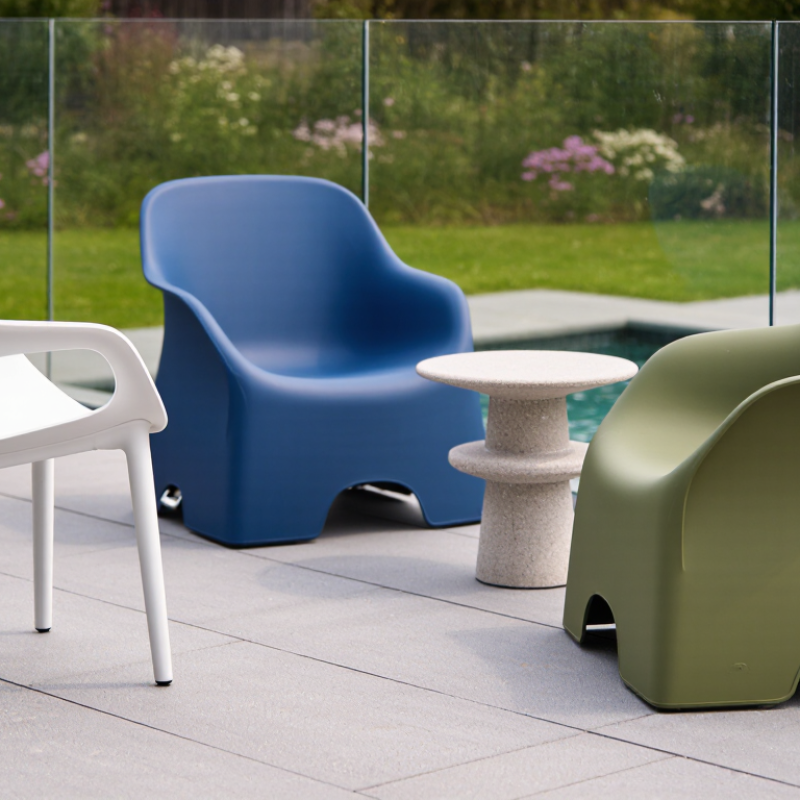
Design trends in 2026 lean toward softer contours, textured finishes, and colors drawn from stone, sand, and muted greens. Some chairs pair a rotomolded seat with metal or timber legs, adding a warmer look while keeping the shell practical. Designers are also exploring recycled-content plastics and replaceable components. These choices need scrutiny: recycled feedstock can vary in color and performance, and a “recyclable” label does not guarantee local collection. The details matter. A chair that drains well but becomes slippery when wet may disappoint beside a pool. Likewise, a bold sculpted shape can look inviting yet feel tiring during a long meeting. Testing samples in the actual setting remains useful, even if it slows the selection process.