


Why Choose FPGA Chips for Global Sourcing?
Why Choose FPGA Chips for Global Sourcing? The answer begins with flexibility. An Fpga Chip can support industrial controls, medical instruments, communications equipment, and embedded systems. Engineers can configure its logic after manufacturing. This reduces redesign pressure when product requirements change. It also helps manufacturers maintain one hardware platform across several markets.
Global sourcing expands access to established semiconductor producers, specialized distributors, and regional inventory. However, price alone should never guide the decision. A reliable purchasing process examines the manufacturer’s quality systems, production history, lifecycle notices, and technical documentation. Buyers should request date codes, origin records, inspection reports, and traceability documents. Details matter. Authorized supply channels can reduce counterfeit risks and improve support during shortages.
Technical evaluation remains essential. Teams should compare logic capacity, I/O standards, memory resources, power requirements, development tools, and operating temperature ranges. They should also confirm package availability and long-term supply commitments. A sample board may pass testing, while a larger production batch reveals thermal or timing issues. That happens. Independent testing and staged qualification provide stronger evidence than a supplier promise. Engineers should document every assumption, including software compatibility and replacement options.
Global sourcing can lower costs and strengthen resilience, but it is not automatically safer or simpler. Currency changes, transport delays, regional standards, and communication gaps may affect delivery. A thoughtful sourcing strategy balances performance, price, reliability, and support. The process is rarely perfect. Regular supplier reviews and honest risk assessments keep the Fpga Chip supply chain dependable.
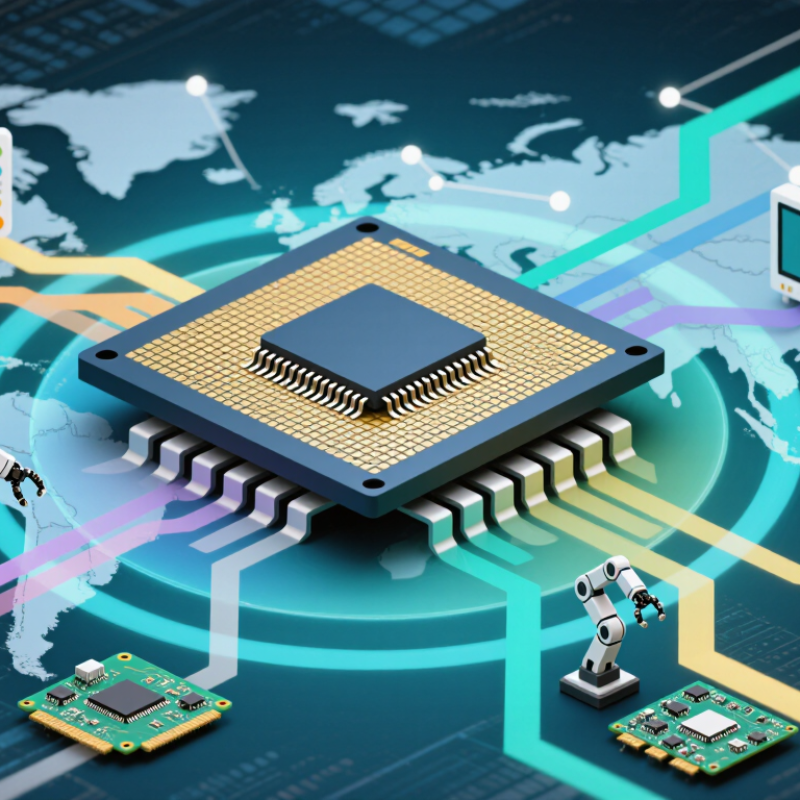
What Are FPGA Chips and How Do They Work?
FPGA chips are integrated circuits that users can configure after manufacturing. FPGA means field-programmable gate array. Unlike fixed-function chips, they contain programmable logic blocks, memory, registers, and routing resources. Engineers connect these elements to create custom digital hardware. A design can process several operations at the same time. This parallel structure often suits imaging, industrial control, communications, and data acquisition.
The device follows a hardware description written in a language such as Verilog or VHDL. Design software converts that description into a configuration file, often called a bitstream. After loading, the chip’s logic blocks behave like the planned circuit. For example, a sensor board can receive signals, filter samples, and store results within tightly controlled timing. In a laboratory check, engineers may inspect clock stability, input voltage levels, heat, and configuration time. Small timing errors matter.
Sourcing FPGA chips globally requires more than comparing unit prices. Buyers should verify package details, temperature ratings, production status, documentation, and traceability. A sample may work on a bench yet fail after long operation near a motor or converter. That is an easy mistake. Engineers should also test the actual supply batch, not only an early sample. FPGA development can require specialized software and skilled verification, which affects the total project cost. Reconfiguration is powerful, but it is not free. Some designs become unnecessarily complex because teams assume every function belongs inside the FPGA. Careful partitioning between the FPGA, memory, sensors, and processors usually produces a more dependable system.
Why Choose FPGA Chips for Global Sourcing? — What Are FPGA Chips and How Do They Work?
| Data Dimension | Factual FPGA Information | How It Works | Global Sourcing Relevance |
|---|---|---|---|
| Basic Definition | An FPGA is a field-programmable gate array: an integrated circuit whose digital logic can be configured after manufacturing. | Design files configure programmable logic blocks, routing resources, memory, and input/output functions to create a custom hardware circuit. | One device family can support multiple product versions, reducing the need to source a separate fixed-function chip for every design. |
| Core Logic Structure | Most FPGAs contain configurable logic blocks built from lookup tables, flip-flops, programmable routing, and configuration memory. | A lookup table implements selected Boolean functions, while flip-flops store state for sequential operations. Routing connects these resources into a system. | The same hardware platform can be adapted for different regional requirements, interfaces, algorithms, or control functions. |
| Processing Method | FPGAs use spatial parallelism rather than relying only on sequential instruction execution. | Many logic operations, data paths, and pipeline stages can operate concurrently in dedicated hardware. | Parallel execution is useful for communications, industrial control, image processing, signal processing, and real-time data movement. |
| Reprogrammability | Many FPGAs can be reconfigured electrically, although configuration technology varies by device. | A configuration bitstream defines the circuit behavior. Some devices load it at startup, while others retain configuration in non-volatile memory. | Firmware-level updates can extend product life and allow design corrections without changing the physical PCB or sourcing a new silicon design. |
| On-Chip Memory | Common embedded memory resources include block RAM, distributed RAM, and, on some devices, larger dedicated memory structures. | Memory blocks store buffers, coefficients, lookup tables, instructions, and intermediate data close to the programmable logic. | Integrated memory can reduce external component count, simplify procurement, and support compact system designs. |
| Digital Signal Processing | Many modern FPGAs include dedicated arithmetic units for multiplication, addition, accumulation, and related signal-processing operations. | Dedicated arithmetic blocks execute mathematical operations efficiently and can be connected into parallel pipelines. | This supports high-throughput applications such as wireless infrastructure, radar, video, audio, measurement, and machine vision. |
| I/O and Interface Flexibility | FPGAs commonly provide configurable digital I/O standards and may include high-speed serial transceivers, depending on the device class. | I/O banks and interface logic can be configured to match voltage standards, timing requirements, and communication protocols supported by the device. | Flexible interfaces help one design connect with different sensors, converters, memory devices, and industrial or communications equipment. |
| Latency and Determinism | Hardware pipelines can provide predictable timing and low processing latency for properly designed applications. | Operations are arranged as fixed hardware data paths, reducing dependence on operating-system scheduling or software instruction flow. | Predictable response is valuable in factory automation, motor control, test equipment, safety systems, and time-sensitive communications. |
| Development Workflow | FPGA designs are commonly described with hardware description languages, schematic tools, or high-level synthesis tools, followed by synthesis, placement, routing, and configuration-file generation. | The toolchain converts the design into a device-specific implementation and checks timing, resource use, and connectivity before programming. | A documented, repeatable workflow makes design transfer, engineering collaboration, and multi-region production validation easier. |
| Power Considerations | Power consumption depends on process technology, clock frequency, toggle activity, I/O loading, memory use, and the amount of configured logic. | Dynamic power generally increases with switching activity, capacitance, voltage, and frequency; static power depends on the device technology and operating conditions. | Power budgets, thermal design, package selection, and operating temperature must be evaluated before selecting a globally sourced device. |
| Performance Trade-Off | FPGAs can deliver high parallel throughput and deterministic control, but they generally require more design effort than conventional processors. | Performance is achieved by tailoring hardware data paths, pipelines, memory access, and interfaces to the application. | They are most suitable when flexibility and hardware acceleration justify engineering, verification, and programming costs. |
| Product-Life-Cycle Value | Reconfigurable logic can accommodate changing standards, protocols, algorithms, and field requirements without redesigning the silicon. | The physical device remains the same while the configuration and supporting software can be revised within the device’s technical limits. | This can reduce redesign risk and help maintain supply continuity across long-lived industrial, communications, and embedded products. |
| Key Selection Criteria | Important criteria include logic capacity, memory size, arithmetic resources, I/O count, transceiver capability, package, speed grade, power, temperature range, and lifecycle status. | The selected device must provide sufficient resources and timing margin for the intended design under its specified electrical and environmental conditions. | A clear specification enables qualified cross-region alternatives while avoiding incompatibility in package, voltage, timing, firmware, or certification requirements. |
Note: FPGA capabilities vary significantly by device family and configuration. Always verify electrical ratings, supported interfaces, temperature range, package compatibility, availability, and lifecycle information against the latest official technical documentation.