

Why Choose Ultrapure Water Equipment for Your Business?
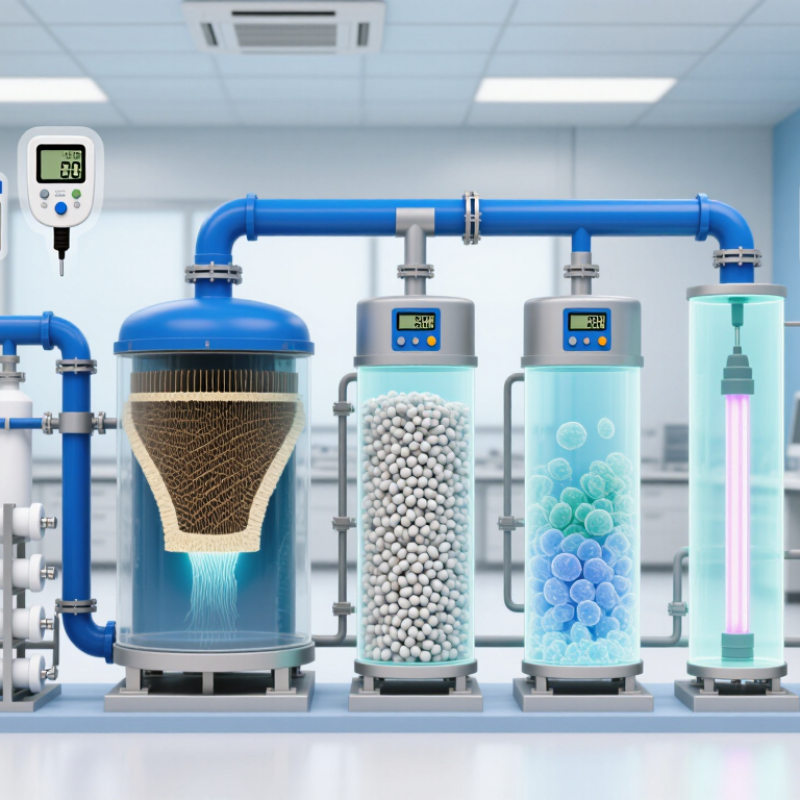
Choosing Ultrapure Water Equipment is a practical decision for businesses that depend on consistent water quality. Laboratories, pharmaceutical manufacturers, electronics plants, and healthcare facilities may require water with extremely low levels of ions, particles, microorganisms, and organic compounds. A well-designed system can combine pretreatment, reverse osmosis, deionization, electrodeionization, ultraviolet treatment, and final filtration. Each stage has a specific role. Together, they protect sensitive processes and reduce avoidable contamination risks.
The real value appears during daily operation. A trained technician can check conductivity, resistivity, temperature, and microbial trends before problems reach production. For example, water approaching 18.2 MΩ·cm may support demanding laboratory applications, but that number alone does not prove complete quality. Sampling methods, storage tanks, pipe materials, and cleaning procedures also matter. Small details matter.
Ultrapure Water Equipment should match your application, output volume, facility layout, and regulatory expectations. A qualified supplier should provide documented specifications, installation support, maintenance guidance, and calibration records. Ask about alarms, data logging, replacement intervals, and emergency service. These details influence long-term reliability more than a polished brochure.
It is not a magic solution.
Even advanced equipment can underperform when operators skip routine checks or delay filter replacement. Businesses should review total ownership costs, not only the purchase price. Energy use, consumables, validation, downtime, and staff training deserve careful attention. The best choice is not always the most complex system. It is the system your team can operate correctly, verify consistently, and improve when real-world conditions expose its weaknesses.
Defining Ultrapure Water: 18.2 MΩ·cm Resistivity Under ASTM D1193
Why Choose Ultrapure Water Equipment for Your Business?
Defining Ultrapure Water: 18.2 MΩ·cm Resistivity Under ASTM D1193
Ultrapure water is measured by more than appearance. Under ASTM D1193-19, Type I water can reach 18.2 MΩ·cm resistivity at 25°C. That equals approximately 0.055 µS/cm conductivity. The number is highly specific. It shows extremely low ionic contamination, not guaranteed sterility or complete chemical purity.
In a working laboratory, this distinction matters. A water system may feed chromatography, trace analysis, cell culture, or precision cleaning. ASTM D1193-19 identifies key water-quality parameters, including resistivity, conductivity, organic carbon, bacteria, and endotoxins. USP General Chapter <1231> also treats water quality as application-dependent, especially for pharmaceutical processes. Equipment selection should follow the test method, not marketing language.
A strong system monitors resistivity continuously. It also records temperature and alerts operators before results drift. Daily checks can reveal exhausted cartridges, poor sanitization, or a failing membrane. Small details matter here. A clean-looking reservoir can still hold dissolved contaminants.
There is an uncomfortable limitation. No purifier produces perfect water forever. Air exposure, tubing materials, and storage time can reduce quality quickly. For that reason, users should validate sampling points and review maintenance records. The 18.2 MΩ·cm reading is a useful target, but it is not the entire quality story.
Purification Stages: RO Removes 95–99% of Dissolved Salts Before DI
In my experience, ultrapure water equipment protects business processes that depend on consistent water quality. The purification train matters more than a single filter. Reverse osmosis, or RO, usually removes 95–99% of dissolved salts before deionization, or DI. This reduction gives the DI stage a lighter workload.
RO pushes feed water through a semi-permeable membrane under pressure. Salts, minerals, and many dissolved contaminants remain in the concentrate stream. The purified flow continues toward storage or DI treatment. Actual performance depends on feed quality, temperature, membrane condition, and operating pressure. A cold morning can change the readings more than some operators expect.
DI then captures remaining ions that RO does not remove. This sequence can extend resin life and help maintain low conductivity. In a working facility, technicians should check pressure, flow, conductivity, and rejection rates regularly. Small changes often reveal scaling or membrane fouling early. I have seen teams focus only on final water readings. That approach can hide rising operating costs. It is not always enough. Water testing should also match the application, whether it supports laboratory instruments, manufacturing rinses, or sensitive cleaning processes. Records, calibration checks, and scheduled maintenance make the system easier to trust during audits and daily production.
Microbial Control: 254-nm UV and 0.2-µm Filtration Protect Water Quality
Why Choose Ultrapure Water Equipment for Your Business?
Microbial Control: 254-nm UV and 0.2-µm Filtration Protect Water Quality
Ultrapure water systems need more than a polished appearance. They need measurable microbial control. A 254-nm UV reactor damages microbial DNA and limits reproduction. However, UV performance depends on dose, water clarity, lamp age, and flow rate. The U.S. EPA UV Disinfection Guidance Manual emphasizes validated dose delivery, not lamp wattage alone. For certain public-water targets, it uses 40 mJ/cm² as a reference benchmark. This value is not universal.
A 0.2-µm membrane adds a physical barrier after UV treatment. It can retain many bacteria and particles under validated operating conditions. It does not reliably remove every virus. PDA Technical Report No. 26 stresses filter validation, integrity testing, and controlled operating parameters. That matters when water feeds cell culture, analytical instruments, or sensitive manufacturing steps.
The strongest design combines both controls. UV reduces microbial activity before filtration. The membrane then captures remaining cells and debris. Operators should monitor UV intensity, differential pressure, flow, and filter integrity. Keep records.
Small gaps become expensive.
In practice, even a strong system can fail through poor sampling or delayed filter replacement. That uncomfortable detail deserves attention. Equipment selection should follow a documented risk assessment, routine microbiological testing, and the relevant quality standard. Good water quality is not a single reading. It is consistent control, verified over time.
Why Choose Ultrapure Water Equipment for Your Business? - Microbial Control: 254-nm UV and 0.2-µm Filtration Protect Water Quality
A practical comparison of complementary microbial-control technologies used in ultrapure water systems
| Evaluation Dimension | 254-nm UV Treatment | 0.2-µm Membrane Filtration | Recommended System Practice |
|---|---|---|---|
| Primary microbial-control principle | Ultraviolet-C energy at approximately 254 nm damages microbial DNA or RNA, preventing replication when the delivered UV dose is adequate. | Physical size-exclusion removes microorganisms and particles that are retained by the membrane under validated operating conditions. | Use UV and final filtration as complementary barriers rather than treating either technology as a universal purification step. |
| Main strength | Inactivates microorganisms without adding chemicals or changing the water’s mineral composition. | Provides a physical barrier at the point of use and can help reduce microbial passage into downstream equipment or processes. | Combining inactivation with physical removal improves control across different operating conditions. |
| What it does not reliably remove | Does not generally remove microorganisms, particles, dissolved chemicals, or endotoxins from the water; it inactivates susceptible organisms. | Does not generally remove dissolved salts, dissolved organic compounds, or gases; virus retention depends on membrane design and validation. | Specify additional treatment stages when ionic purity, organic removal, endotoxin reduction, or viral control is required. |
| Critical performance factors | UV dose, flow rate, lamp output, sleeve cleanliness, water UV transmittance, and exposure time. | Pore-size rating, membrane integrity, differential pressure, flow rate, temperature, compatibility, and prefiltration. | Set operating limits and verify performance using documented monitoring and maintenance procedures. |
| Potential failure mode | Insufficient UV dose caused by lamp aging, fouling, excessive flow, low UV transmittance, or an unverified sensor. | Breakthrough or bypass caused by membrane damage, poor sealing, incorrect installation, excessive pressure, or inadequate integrity testing. | Use alarms, preventive maintenance, leak checks, and routine microbial monitoring to detect loss of control. |
| Maintenance considerations | Clean or replace the quartz sleeve as needed, monitor lamp intensity, and replace lamps according to validated output and service requirements. | Replace filters based on validated service life, pressure drop, microbial results, or integrity-test outcomes. | Maintain records for lamp status, filter changes, pressure, flow, sanitization, and test results. |
| Best installation position | Often installed upstream of a final point-of-use filter to reduce the microbial load entering the distribution or polishing section. | Commonly installed as a final or point-of-use barrier where the water is dispensed or enters a sensitive process. | Position equipment according to water quality, distribution-loop design, flow demand, and the required control strategy. |
| Operational benefit for businesses | Chemical-free microbial inactivation can support continuous operation when UV exposure conditions are controlled. | A final physical barrier can help protect critical applications from particles and microorganisms reaching the outlet. | Layered control can improve consistency, reduce contamination risk, and support documented quality requirements. |
| Important validation note | Microbial inactivation performance must be verified for the actual flow rate, water quality, UV dose, and target organisms. | A nominal or absolute pore-size claim alone does not establish complete sterility; membrane performance and system integrity require validation. | Select equipment based on applicable industry requirements, risk assessment, water specifications, and validated process performance. |
Industry Standards: USP <1231> and ISO 3696 Grades 1–3 Explained
Ultrapure water equipment matters because water quality changes product safety, testing accuracy, and operating costs. USP General Chapter <1231> treats pharmaceutical water as a process system, not merely a final sample. Its guidance connects water quality with intended use, system design, sanitization, storage, and routine monitoring. USP <643> sets a total organic carbon limit of 500 µg/L for applicable pharmaceutical waters. USP <645> also uses conductivity testing, with a Stage 1 limit of 1.3 µS/cm at 25°C for purified water.
ISO 3696 defines laboratory water in three grades. Grade 1 allows conductivity up to 0.1 µS/cm at 25°C. Grade 2 permits up to 1.0 µS/cm, while Grade 3 permits up to 5.0 µS/cm. These values help laboratories match equipment performance with analytical risk. Grade 1 suits trace analysis and sensitive instruments. Grade 2 supports routine analytical work. Grade 3 fits basic preparation and washing tasks. ISO 3696 is not a substitute for pharmaceutical compliance.
Real systems are less perfect. Temperature shifts can distort conductivity readings. Biofilm can develop inside quiet pipe sections. WHO Technical Report Series No. 1033, Annex 3, emphasizes controlled design, continuous monitoring, and documented qualification for water systems. Operators should record conductivity, TOC, microbial trends, sanitization results, and alarm events. Equipment selection should follow the required grade, flow demand, materials, and validation plan—not impressive specifications alone. That distinction is often missed.
Business Value: 70–85% RO Recovery Can Reduce Feedwater Demand
Why Choose Ultrapure Water Equipment for Your Business?
Business Value: 70–85% RO Recovery Can Reduce Feedwater Demand
Ultrapure water equipment can improve production efficiency by recovering 70–85% of reverse osmosis feedwater. This means less water enters the system for every liter delivered to the process. In a facility using 10,000 liters daily, recovery improvements may save thousands of liters each month. That matters. Lower feedwater demand can also reduce pumping, pretreatment, and wastewater handling costs.
Experienced water treatment operators do not rely on recovery percentages alone. They check conductivity, pressure, temperature, flow rate, and reject quality during real production cycles. Feedwater chemistry changes, and membranes respond to those changes. A recovery setting that works in winter may increase scaling risks during warmer months. The equipment must match the site’s water analysis and operating schedule.
Tips: Measure recovery at the inlet and product outlet, not from estimates. Inspect pretreatment filters regularly. Keep a written log of pressure and conductivity changes. Small shifts often reveal fouling before performance drops.
A higher recovery rate is not automatically better. Pushing the system too far can shorten membrane life or increase cleaning frequency. I have seen attractive calculations fail because they ignored downtime and maintenance water. The first estimate is rarely perfect. Review actual readings after installation, then adjust recovery carefully with qualified technicians and documented procedures.
